
Understanding the dementia brain can change everything about how you experience even the hardest caregiving days.
There are days when dementia caregiving feels impossible.
The same question gets asked over and over.
Your loved one insists someone stole their purse.
They tell you they want to go home while they’re sitting in their own living room.
They become angry because you asked them to take a shower.
They cry when you leave.
If you’ve ever felt frustrated, heartbroken, exhausted, or guilty for losing your patience, I want you to know something.
Those feelings don’t make you a bad caregiver.
They make you human. 💜
Caring for someone whose brain is changing is one of the hardest things a person can do. No one can fully prepare you for the emotional roller coaster of watching someone you love slowly change while still showing up for them every single day.
🫂 Two People Are Having a Hard Time
One of the things I remind caregivers all the time is this:
There are two people having a difficult experience.
The person living with dementia.
And the person caring for them.
Your loved one is trying to navigate a brain that no longer processes the world the way it once did.
You’re trying to respond to behaviors you’ve never experienced before and were never taught how to handle.
Both experiences are hard.
Both deserve compassion.
The Behaviors Are Real. So Are Your Feelings.
When someone accuses you of stealing, it hurts.
When they don’t recognize you, it hurts.
When they ask the same question for the fifteenth time, it’s exhausting.
When they wake you up several times throughout the night, you become sleep deprived.
When they refuse care or become angry, you may question everything you’re doing.
Understanding what’s happening inside the brain doesn’t suddenly make those moments easy.
It doesn’t erase your grief.
It doesn’t erase your exhaustion.
It doesn’t make the behaviors disappear.
But it does answer one of the biggest questions caregivers ask me every day.
Why are they doing this?
🧠 Understanding the Dementia Brain Behind the Behavior
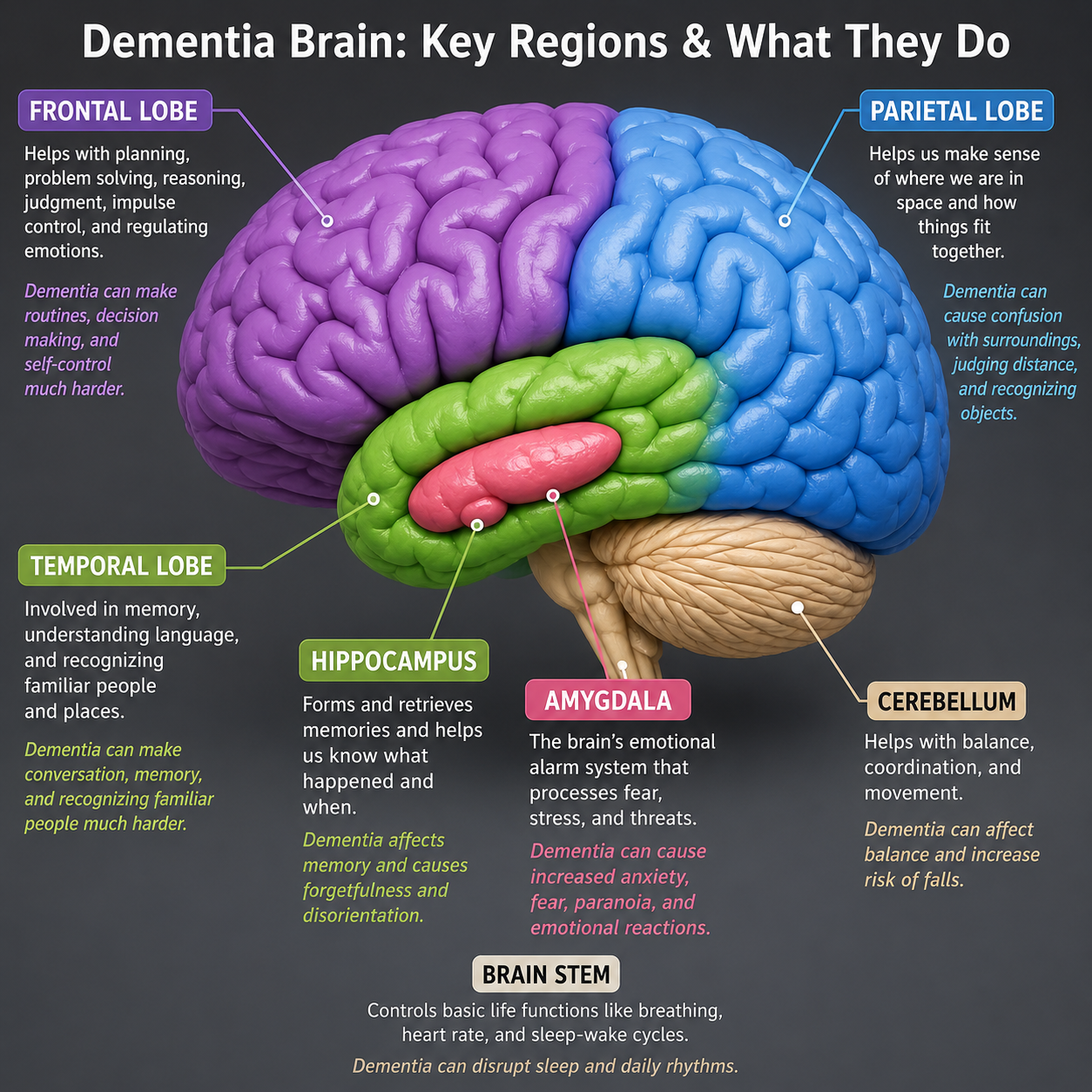
One of the most powerful things I learned while working with people living with dementia is that behaviors almost always have an explanation.
When we stop looking only at the behavior and start looking at the brain, things begin to make more sense.
- The hippocampus is responsible for forming new memories. As dementia affects this area, your loved one may forget they already asked a question, forget where they placed their wallet, or forget that you already answered them.
- The frontal lobe helps us reason, solve problems, and control our emotions. As it changes, logic becomes much harder. That’s why explaining or correcting often doesn’t work the way we hope it will.
- The amygdala is the brain’s fear center. As confusion increases, the brain may interpret everyday situations as threatening. That’s why anxiety, suspicion, aggression, or accusations can happen so quickly.
- The parietal lobe helps us understand where we are and how we interact with the world around us. As dementia affects this area, familiar places may suddenly feel unfamiliar. Home may no longer feel like home.
The behaviors begin to make sense when we understand what’s happening inside the brain.
Understanding the Dementia Brain Doesn’t Remove the Hard. It Changes How We Carry It.
I want to be honest with you.
Learning why these behaviors happen won’t suddenly make caregiving easy.
You’ll still have difficult days.
You’ll still feel overwhelmed sometimes.
You’ll still need breaks.
You’ll still cry.
You’ll still grieve the changes you’re seeing.
But understanding the dementia brain removes one very heavy burden.
It helps you stop wondering if your loved one is doing these things on purpose.
Because they’re not.
They’re responding to a brain that is changing in ways they cannot control.
That doesn’t make the behavior easier.
But it often makes it easier to respond with compassion instead of feeling personally attacked.
Sometimes, that’s enough to completely change the interaction.
Compassion Is for Caregivers Too
As caregivers, you’re often so focused on taking care of everyone else that you forget to offer yourself the same compassion.
You are making hundreds of decisions every day.
You’re juggling appointments, medications, meals, safety concerns, and emotions.
You’re grieving someone who’s still here.
You’re carrying responsibilities that many people around you don’t fully understand.
If you’re tired…
If you’re frustrated…
If you’ve cried in your car after leaving a visit…
If you’ve ever wondered whether you’re doing enough…
Please hear this.
You are not failing.
You are caring for someone whose brain is changing, and that is incredibly hard.
Give yourself the same grace you so freely give the person you love. 🤍
✨ My Hope for You After Understanding the Dementia Brain
My hope isn’t that you become the perfect caregiver.
There is no such thing.
My hope is that you feel a little less alone.
A little more confident.
A little more prepared.
And the next time a behavior happens, instead of immediately asking,
“Why are they doing this?”
You’ll pause for just a moment and ask,
“What might their brain be experiencing right now?”
That one question has the power to change the way we respond.
🤝 Help Others Understand Too
One of the hardest parts of dementia caregiving is feeling like you’re carrying all of the understanding by yourself.
Your siblings may not understand.
Friends may think your loved one is “just being difficult.”
Visitors may take the behaviors personally.
Even well meaning family members sometimes respond in ways that increase fear and frustration simply because they don’t understand what’s happening inside the dementia brain.
That’s exactly why I created my Dementia Awareness Cards.
Each card explains a common dementia behavior in a simple, compassionate way so family members, friends, neighbors, and professionals can better understand what your loved one may be experiencing.
Because when more people understand the brain, they respond with more patience, more empathy, and more compassion.
And that doesn’t just help the person living with dementia.
It helps you, too.
If you’re looking for an easy way to help others understand dementia and support your caregiving journey, I invite you to check out my Dementia Awareness Cards.
Because understanding the brain doesn’t remove the hard.
It changes how we carry it. 💜